
Product Categories
News
Contact Us
Tel: +86-0371-65621392Fax: +86-0371-86616825
E-mail: info@haomei.biz
Address:No.14 Waihuan Road, New district, Zhengzhou, China
ZIP: 450046

Working Principle Of Concrete Batching Mixing Plant
Writer:Admin Time:26/02/05The core of a concrete batching mixing plant is to achieve precise proportioning and uniform mixing of aggregates, cement, admixtures and water. Its workflow revolves around a closed loop of four key stages: storage, metering, mixing, and discharge. These systems are interconnected through a PLC control system to ensure stable continuous operation. As export-oriented equipment, our design must consider the material characteristics of different regions (such as the fluctuating moisture content of aggregates in Southeast Asia and the mix proportions required for high-strength concrete in Europe). Therefore, the practical implementation of its working principle needs to adapt to various scenarios.
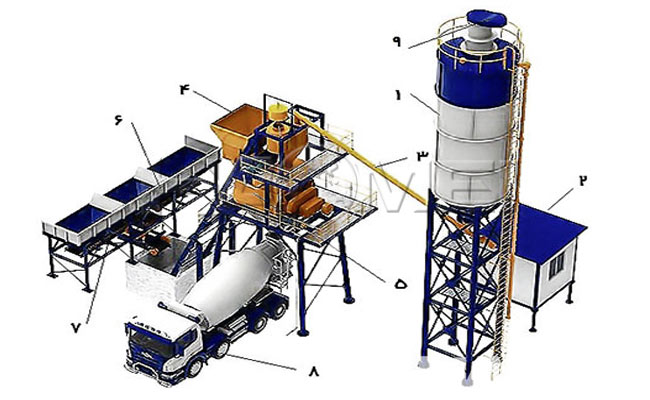
Working principle of concrete batching mixing plant in key systems:
- Storage system: Graded storage and anti-clogging design
Aggregates are fed into enclosed silos by loaders. The silos feature a conical bottom and a vibration-damping device to solve the problem of aggregate bridging and clogging in humid regions—this is the core structure we optimized for the tropical export market. Cement, fly ash, and other powdery materials are stored in sealed tanks equipped with dust collectors on the silo tops and pressure relief valves, meeting EU dust emission standards while preventing the powders from becoming damp and clumping. The liquid admixture storage tank is equipped with a constant temperature heating device, suitable for winter operations in cold regions, ensuring the activity of the additives.
- Metering system: Dynamic compensation and error control
The metering process is the core of proportioning accuracy, employing a combined mode of "aggregate cumulative metering + powder loss-in-weight metering + liquid flow metering". Aggregates are conveyed via belt scales, providing real-time feedback on material weight. The PLC system dynamically adjusts the feeding speed based on the drop value, controlling the error within ±2%. Powder is fed into the metering hopper via a screw conveyor, utilizing the principle of loss-in-weight to correct the conveying volume in real time, adapting to the density differences of different cement grades. Water and admixtures are metered using electromagnetic flow meters, equipped with a return branch, allowing for rapid dosage adjustment to meet the frequently changing concrete formula requirements of export projects.
- Mixing system: Forced mixing and efficiency optimization
The mixing unit adopts a twin-shaft forced mixing structure, a standard configuration for our exported equipment. Two mixing shafts rotate in opposite directions, with blades arranged in a spiral pattern, creating a triple force of shearing, compression, and tumbling. This ensures uniform mixing of aggregates and cementitious materials within 30-90 seconds (the specific time is adjusted according to the concrete strength grade of the exporting country). The main unit liner and blades are made of high-chromium alloy, adaptable to the mixing requirements of high-wear-resistant aggregates in some countries, extending the service life of vulnerable parts.
- Control system: Intelligent linkage and adaptable design
The system employs an industrial-grade PLC + touchscreen control system, with built-in databases of multiple exporting country standard concrete formulas (such as ASTM, BS, and GB standards). Technicians can adjust parameters to adapt to different project requirements. The system has real-time monitoring capabilities, providing early warnings for key parameters such as material metering errors, main unit load, and motor temperature. It also supports remote diagnostics (local network protocols are required for some export regions), facilitating equipment maintenance for overseas customers.
The essence of efficient operation of a concrete batching mixing plant lies in the implementation of the technology of "adaptation - precision - linkage": through structural optimization to adapt to various regional working conditions, precise metering to ensure the quality of the mix proportions, forced mixing to improve mixing efficiency, and intelligent control system to connect the entire process, which not only ensures the stability of concrete quality, but also reduces the actual operation and maintenance costs for overseas customers.
- Previous:[Haomei News]...
- Next:Haomei Concrete Manufacturing Plants...