
Product Categories
News
Contact Us
Tel: +86-0371-65621392Fax: +86-0371-86616825
E-mail: info@haomei.biz
Address:No.14 Waihuan Road, New district, Zhengzhou, China
ZIP: 450046

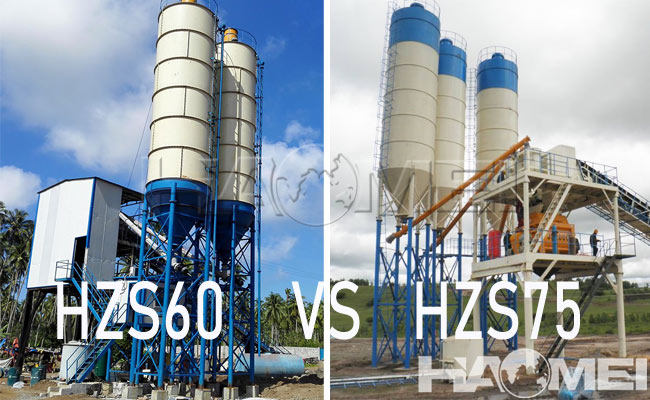
Concrete Batching Plant HZS60 VS HZS75
Writer:Admin Time:25/12/04HZS60 and HZS75 concrete batching plant are two common models of medium-sized concrete batching plants, widely used in construction projects. Their main differences lie in production capacity, equipment configuration and applicable scenarios.
1. Core performance differences
- Production efficiency:
The theoretical production rate of the HZS60 concrete batching plant is 60 cubic meters of concrete per hour, suitable for the daily needs of small to medium-sized projects (approximately 500 cubic meters or less).
The HZS75 concrete batching plant increases this to 75 cubic meters per hour, meeting the daily needs of large projects or commercial concrete plants (600-800 cubic meters), with a significant advantage in peak capacity.
- Mixing machine:
The HZS60 concrete batching plant is equipped with a JS1000 twin shaft forced concrete mixer, with a single discharge of 1 cubic meter, suitable for producing C15-C30 grade concrete.
The HZS75 concrete batching plant uses a JS1500 concrete mixer, with a discharge of 1.5 cubic meters, a faster mixing shaft speed, and can uniformly mix high-grade concrete (such as C40-C60), while extending the life of wear parts by approximately 30%.
- Feeding methods:
The HZS60 concrete batching plant uses a belt conveyor system, continuously transporting aggregates to the concrete mixer via an inclined belt. This is suitable for scenarios with multiple aggregate types and frequent material changes, but the initial investment is higher.
The HZS75 concrete batching plant uses a bucket elevator system, lifting aggregates to the concrete mixer via steel buckets. This system is simple in structure and has low maintenance costs, but the aggregate particle size must be ≤100mm, and the bucket height is limited (usually 3.8 meters).
2. Configuration details comparison:
- Batching system:
The HZS60's PLD1600 batching machine is equipped with 4 aggregate bins, with a weighing accuracy of ±2%, suitable for projects with general concrete quality requirements.
The HZS75's PLD2400 batching machine also has a 4-bin design, but the weighing accuracy is improved to ±1%, and it supports simultaneous batching of 4 types of aggregates, allowing for quick switching between different grades of concrete production and reducing downtime.
- Electrical control
Both models employ a dual-computer control system (industrial PC + PLC), but the HZS75 concrete batching plant typically uses imported brands (such as Siemens and Schneider) for its electrical components (e.g., sensors, frequency converters), resulting in stronger anti-interference capabilities and a failure rate reduced by approximately 40%.
- Environmentally friendly design
The HZS75 concrete batching plant incorporates a pulse dust collector at the top of the powder silo, achieving a dust emission concentration ≤10mg/m³, meeting national environmental standards; the HZS60 concrete batching plant requires additional dust collection equipment to achieve the same effect.
3. Applicable scenarios analysis
HZS60 concrete batching plant applicable scenarios:
Rural road hardening, small-scale water conservancy projects (daily demand ≤ 400 cubic meters)
Precast component factories (producing standardized components such as hollow slabs and curbs)
Projects requiring frequent relocation (modular design, disassembly and assembly cycle only 3-5 days)
HZS75 concrete batching plant applicable scenarios:
Commercial housing construction, municipal roads (daily demand 600-800 cubic meters)
Commercial concrete plants (covering a market within a 10-20 km radius)
Projects requiring the production of special concrete (such as permeable concrete, fiber-reinforced concrete)
4. Cost and benefits
- Initial investment
The initial investment for HZS60 concrete batching plant equipment is approximately US$80,000-100,000, while for HZS75 concrete batching plant, it is approximately US$100,000-150,000. However, the unit production cost (USD/cubic meter) of HZS75 is lower. When producing 600 cubic meters of concrete, HZS60 concrete batching plant requires 10 hours of operation, with equipment wear costs of approximately US$120; HZS75 concrete batching plant only requires 8 hours, with wear costs of approximately US$100.
- Operating costs
Electricity: The HZS60 concrete batching plant has a total power of approximately 110kW, while the HZS75 concrete batching plant has approximately 135kW. Based on 8 hours of operation per day, the HZS75's electricity cost is approximately $3 more.
Labor: The HZS75 concrete batching plant has a higher degree of automation, reducing the need for one operator per shift.
- Payback period
Taking a daily demand of 600 cubic meters of concrete as an example:
HZS60 concrete batching plant: With an equipment lifespan of 8 years, the average annual net profit is approximately $100,000, with a payback period of approximately 2.5 years.
HZS75 concrete batching plant: The average annual net profit is approximately $150,000, with a payback period of approximately 1.8 years.
5. Selection recommendations
Choose HZS60 concrete batching plant: If the project is small-scale, has a limited budget, or requires frequent relocation (e.g., cross-regional construction).
Choose HZS75 concrete batching plant: If the project's daily demand is ≥600 cubic meters, or requires the production of high-grade/specialty concrete, and the site is fixed (e.g., a commercial concrete plant).
- Previous:Mobile Ready Mix Concrete Plant...
- Next:Automated Concrete Mixing Station...