
Product Categories
News
Contact Us
Tel: +86-0371-65621392Fax: +86-0371-86616825
E-mail: info@haomei.biz
Address:No.14 Waihuan Road, New district, Zhengzhou, China
ZIP: 450046

How Does a Concrete Batching Plant Work?
Writer:Admin Time:26/04/03As a sales manager at Haomei Machinery with ten years of experience in exporting concrete batching plants, I've witnessed projects ranging from rural roads in Southeast Asia to skyscrapers in the Middle East. A concrete batching plant is far more than a simple "cement mixer"; it's a sophisticated production system integrating material storage, precise metering, efficient mixing, and intelligent control. Every step of its workflow determines the quality of the concrete and the success or failure of the project.
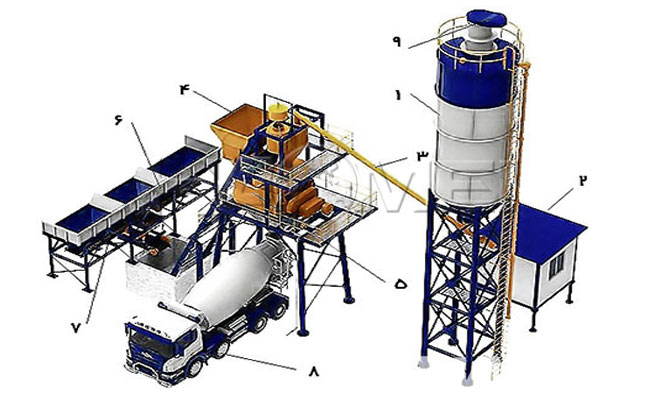
1. Material Preparation: Precise Transfer from Raw Material Silo to Waiting Area
The operation of a concrete batching plant begins with five main raw materials: aggregates (sand and gravel), cement, fly ash, water, and admixtures. In Haomei's HZS series concrete batching plants, the aggregate silos feature a modular design, with capacities ranging from 100 to 500 tons. After the loader delivers the sand and gravel, the vibrating screen automatically grades them, ensuring that different aggregate sizes are precisely matched to the formula requirements.
I once witnessed this on a project in Egypt, where the local dust storms caused the poor sealing of the silos in ordinary batching plants, leading to cement caking due to moisture. Our cement silos are equipped with pressure sensors and moisture-proof devices. During conveying via screw conveyors, the flow rate is monitored in real time, avoiding metering errors caused by moisture – a crucial localization requirement for exported equipment.
2. Precise Metering: The "Heart" of the Concrete batching Plant
The metering system is the core factor determining concrete strength and durability. Haomei concrete batching plants employ triple metering protection:
- Aggregate metering error ≤ ±2%, using dual control of electronic scales and pneumatic valves
- Powder (cement, fly ash) error ≤ ±1%, achieving precise feeding through variable frequency speed control of the screw conveyor
- Water and admixture error ≤ ±0.5%, using combined control of electromagnetic flow meters and quantitative pumps
Last year, in a high-speed rail project in Malaysia, the client required C50 high-strength concrete. Our HZS180 concrete batching plant, through a PLC intelligent control system, adjusted the admixture ratio in real time, ultimately achieving a 100% concrete strength qualification rate, 3 percentage points higher than local competitors. This experience made me realize that every 0.1% improvement in metering accuracy can extend the lifespan of an engineering project by 5-10 years.
3. High-Efficiency Mixing: The Core Technology of the Twin-Shaft Forced Mixing Unit
The mixing unit is the "brain" of the concrete batching plant. Haomei uses a twin-shaft forced mixing design throughout, with mixing blades made of wear-resistant alloy, extending their service life by three times compared to ordinary materials. During operation, materials are added in a specific order: first, aggregate + water are premixed for 30 seconds, then cement + fly ash are added and mixed for 45 seconds, and finally, admixtures are added to adjust the slump. The total mixing time is controlled within 90 seconds to ensure the uniformity of the concrete.
I encountered an extreme situation on a project in UAE: the local temperature reached 45°C. Ordinary concrete batching plants experienced motor overheating and shutdown due to poor heat dissipation. Our mixing units, however, are equipped with an intelligent temperature control system, using a dual-mode water cooling and air cooling system to ensure continuous operation in high-temperature environments—one of the key reasons why our equipment can operate stably in more than 50 countries worldwide.
4. Discharge and Transportation: Seamless Connection from Mixing Tank to Project Site
After mixing, the hydraulic discharge gate opens, and the concrete enters the mixer truck via a chute. The discharge height of the Haomei concrete batching plant is adjustable between 3.8 meters and 4.5 meters to accommodate different vehicle types. Simultaneously, the control system automatically records the formula, strength grade, and production time of each truckload of concrete, generating a QR code for full traceability.
I recall a port project in Saudi Arabia where the client required 24-hour continuous supply. Our HZS240 concrete batching plant, through a dual-unit parallel design, achieved a capacity of 240 cubic meters per hour, a 40% increase in efficiency compared to traditional single-unit plants. This made me realize that the efficiency of a concrete batching plant depends not only on the performance of individual machines but also on system integration capabilities.
5. Intelligent Control: The "Nerve Center" of a Modern Concrete batching Plant
The Haomei concrete batching plant's control system uses an industrial-grade touchscreen + remote monitoring. The operator only needs to input the concrete grade, and the system automatically matches the optimal formula while simultaneously displaying data from each stage in real time. In one of my projects in Indonesia, the client could monitor the concrete batching plant's operating status and remotely adjust parameters via a mobile app. This significantly reduced human contact and improved safety during the pandemic.
Having worked in the industry for many years, I've observed a pattern: the efficiency of a concrete batching plant is directly proportional to its level of automation. Our latest HZS series concrete batching plant has achieved full automation of the entire process, including "unattended operation + automatic cleaning + fault early warning," reducing labor costs by 60% and material loss rate from the industry average of 3.2% to 0.8%.
6. Industry Experience and Personal Reflections: The Core Logic of Concrete Batching Plant Operation
- Precision is Fundamental:
A fluctuation of 0.05 in the water-cement ratio of concrete results in a strength change of 5-8 MPa, requiring an absolutely accurate metering system.
- Efficiency is Key:
Modern engineering demands increasingly faster concrete supply. Haomei's HZS120 concrete batching plant takes only 3 minutes from raw materials to finished product, 20% faster than the industry standard.
- Adaptability is the Lifeline of Export Equipment:
Raw material characteristics and climate conditions vary greatly between countries. Our batching plants allow for parameter adjustments, enabling customers to optimize formulas according to local conditions.
The working principle of a concrete batching plant may seem simple, but it is actually the culmination of modern industrial technology. As a sales manager, I have witnessed too many engineering problems caused by improper equipment selection—some customers choose equipment from small manufacturers to save costs, only to find that inaccurate metering leads to substandard concrete strength, resulting in rework losses far exceeding the equipment price difference.
At Haomei, we consistently adhere to the design philosophy of "precision, efficiency, and durability". Every concrete batching plant undergoes 120 hours of continuous operation testing before leaving the factory, ensuring stable operation under any working conditions worldwide. This is the fundamental reason why our equipment has won the trust of customers in markets across Asia, Africa, and the Middle East.
Next time you see the towering silos and running main units of a concrete batching plant, consider this: behind every cubic meter of concrete lies the "magic" of a precision system completing operations in mere seconds—this is the working art of concrete batching plants, and it is the pursuit that Haomei Machinery has maintained for ten years.
- Previous:Small Concrete Batching Plant Supplier...
- Next:Cost of Setting Up a Ready Mix Concrete Plant...