
Product Categories
News
Contact Us
Tel: +86-0371-65621392Fax: +86-0371-86616825
E-mail: info@haomei.biz
Address:No.14 Waihuan Road, New district, Zhengzhou, China
ZIP: 450046

How Does A Mobile Concrete Plant Work?
Writer:Admin Time:26/09/23When inquiring about equipment, many clients focus primarily on production capacity, price, and after-sales service, often lacking insight into the internal concrete production process of a mobile concrete plant. As an export specialist at Haomei Machinery, I often tell clients that understanding the equipment's workflow is key to truly appreciating its value. Essentially, a YHZS series mobile concrete plant compresses the entire production system of a small-scale commercial concrete plant onto a single trailer chassis; it continuously produces high-quality concrete through four core stages: graded weighing, centralized conveying, forced mixing, and automatic discharging.
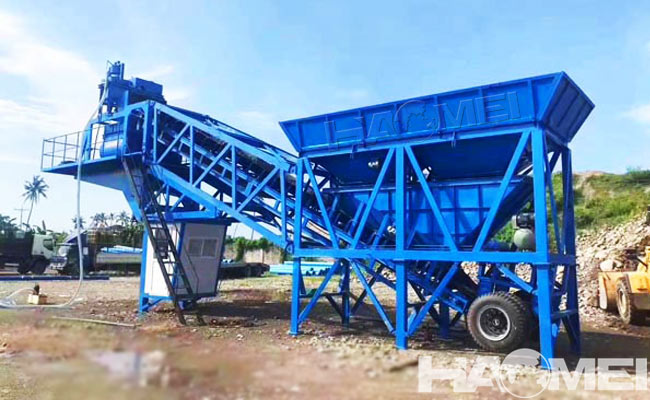
Stage 1: Aggregate Grading, Batching, and Weighing
Operations begin at the aggregate batching bins located at the front of the unit. Taking the YHZS35 mobile concrete plant as an example, it is equipped with a PLD1200 three-bin batching machine capable of simultaneously storing three types of aggregates: sand and two sizes of crushed stone. During operation, pneumatic arc gates at the bottom of the bins open sequentially according to a PLC-preset program; aggregates are transported via a horizontal belt conveyor into a weighing hopper for cumulative weighing. The process employs a dual-measurement system—combining electronic belt scales and weighing hoppers—to keep aggregate weighing accuracy within ±2%. Once weighing is complete, the hopper gate opens, dropping the aggregates onto an inclined belt conveyor, which lifts them to the aggregate hopper atop the main mixer, ready for charging. This stage determines the precision of the mix ratio framework and serves as the first critical checkpoint for ensuring the stability of the finished concrete's strength.
Stage 2: Independent Weighing of Powders and Liquids
Simultaneous to aggregate processing, the weighing of cement, water, and admixtures takes place. Cement is conveyed from the associated cement silo into the cement weighing hopper via a screw conveyor and measured using electronic load cells, achieving an accuracy of ±1%. Water is pumped into the water weighing hopper, while admixtures are drawn separately via metering pumps; both are weighed independently with an accuracy of ±1%. This architecture—weighing powders and liquids separately—prevents aggregate weighing errors from interfering with the mix ratio, marking a key distinction between industrial-grade concrete mixing plants and simple drum concrete mixers. All weighing data is transmitted in real-time to the control cabinet; automatic re-weighing or alarms are triggered if deviations exceed limits, ensuring mixing accuracy at the source.
Stage 3: Twin-Shaft Forced Mixing
Four types of materials are fed sequentially into the JS750 twin-shaft concrete mixer. Inside the mixer, two counter-rotating shafts drive high-strength, wear-resistant blades, subjecting the materials to shearing, convection, and compression. This ensures the thorough and uniform mixing of aggregates, cement, and water within a standard 60-second cycle. With a nominal capacity of 750L, the mixer yields approximately 0.75 cubic meters per batch; while the theoretical output is 35 m³/h, the actual stable capacity during continuous operation reaches 30–32 m³/h. The twin-shaft design offers the advantages of a short mixing path and high homogeneity, preventing segregation even when producing dry-stiff or low-slump concrete—a technical feature that makes the YHZS series mobile concrete batching plant suitable for diverse projects such as road, bridge, and hydraulic engineering.
Stage 4: Discharge and Cycle Transition
Once mixing is complete, the pneumatic discharge gate at the bottom of the mixer opens, and the finished concrete flows directly via a chute into a waiting concrete mixer truck or hopper. The discharge process takes approximately 8–10 seconds, after which the gate closes and an internal spray system automatically rinses away residual material to prevent buildup from affecting the quality of the next batch. The entire process is seamlessly coordinated by a PLC program; the workflow—spanning from aggregate feeding and weighing for one batch to the start of mixing for the next—forms a continuous production line capable of a stable output exceeding 240 m³ of finished concrete per 8-hour shift.
The Control System: The Brain of the Entire Operation
A fully automated PLC control system, integrated into the side-mounted electrical cabinet, governs all four stages of the process. Operators use a touchscreen to set mix ratios, batch counts, and production volumes, while the system automatically manages the entire sequence—proportioning, feeding, mixing, and discharging—and records production data, cumulative volume, and fault information in real-time. Operators need only monitor material levels and equipment status; even general technicians can operate the system independently after brief training, making the mobile station an ideal choice for rapid deployment across dispersed overseas projects.
Based on my hands-on experience, understanding the "weighing–conveying–mixing–discharging" workflow allows customers to make clear assessments during the selection process—such as whether the number of aggregate bins is sufficient, whether the mixer type aligns with project requirements, and whether the control system supports remote monitoring. The Haomei YHZS series mobile concrete plant is optimized around this market-proven production workflow, enabling the equipment to consistently produce commercial-grade concrete, even at remote job sites.
- Previous:[Haomei News]...
- Next:YHZS Series China Mobile Concrete Batching Plant...