
Product Categories
News
Contact Us
Tel: +86-0371-65621392Fax: +86-0371-86616825
E-mail: info@haomei.biz
Address:No.14 Waihuan Road, New district, Zhengzhou, China
ZIP: 450046

Cost Effective Portable Concrete Mixing Plants
Writer:Admin Time:26/08/20As someone with over a decade of experience exporting concrete mixing plant equipment, I've worked with numerous engineering clients worldwide and discovered a common misconception: many people use the bare machine price as the sole decision-making criterion when purchasing portable concrete mixing plants, neglecting the full lifecycle cost from equipment arrival, commissioning, relocation, and decommissioning. In my view, the core competitiveness of portable concrete mixing plants has never been "lower unit price," but rather its ability to minimize overall project costs through flexible deployment, efficient reuse, and low-consumption maintenance. Understanding this hidden cost is far more valuable than worrying about a few thousand dollars in price difference.
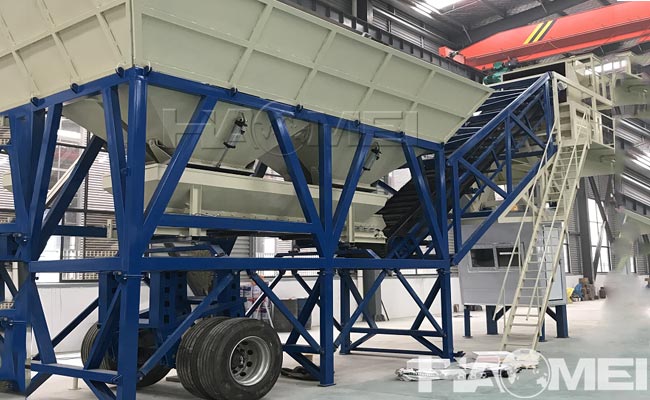
Many clients don't realize that in the initial setup cost of traditional stationary concrete mixing plants, the expenses for civil engineering, foundation construction, installation, and commissioning typically account for 10%–15% of the equipment price, equivalent to $8,000–$15,000. This is compounded by a 7–10 day construction period; every day the project is delayed in commissioning means an additional day of labor and site loss. One of the core advantages of a qualified portable concrete batching plant is that it requires no foundation design; it only needs a leveled and hardened ground surface to be placed. Taking the entire Haomei portable batching plant series as an example, the entire machine is fully commissioned before leaving the factory, and can be put into operation within 24 hours of arrival. This not only saves on civil engineering and installation costs but also directly benefits the customer by advancing the project timeline. For overseas projects with tight schedules, this hidden value often far exceeds the price difference of the equipment itself.
The most fundamental difference between portable and fixed concrete batching plants is the reusability of the asset. Many small and medium-sized projects are small in scale and scattered in location. Purchasing a fixed plant for a single project results in it sitting idle and depreciating in value, leading to poor resale liquidity and extremely low asset utilization. In contrast, mobile concrete batching plants do not require disassembly of core components; the entire machine can be towed and moved, allowing one unit to continuously serve multiple scattered projects. Taking the Haomei YHZS50 portable concrete plant model as an example, if it serves three consecutive small to medium-sized projects, the equipment cost per project is more than 40% lower than purchasing a fixed station with the same capacity. Furthermore, after its service life, the residual value of mobile equipment is generally 15%–20% higher than that of fixed concrete batching plants, demonstrating significant advantages in asset liquidity and value preservation.
Another easily overlooked long-term expense is operation and maintenance (O&M) and energy costs. Some low-priced models rely on reduced features and the use of non-standard components to lower prices, leading to difficulties in procuring spare parts and high replacement costs later on. A single downtime of ten days to half a month due to a malfunction results in losses far exceeding the initial savings on the purchase cost. Haomei's entire series of portable concrete mixing plants has a core component standardization rate of over 90%, and the procurement cost of vulnerable parts is more than 30% lower than that of niche models. Combined with our spare parts warehousing network in key markets such as Southeast Asia, Africa, and the Middle East, we can minimize downtime. Meanwhile, the equipment has undergone power system optimization, resulting in a stable power consumption of 0.7–0.8 kWh per cubic meter of concrete, approximately 15% lower than older models in the industry. This long-term energy saving translates into considerable benefits.
I often tell my customers that choosing concrete mixing equipment isn't about choosing the "cheapest tool," but rather the "most cost-effective asset." A truly high-quality portable concrete mixing plant should be designed with the customer's entire lifecycle in mind from the very beginning, not just focusing on price. As an exporter, Haomei consistently adheres to this approach, avoiding simple price wars and instead optimizing costs at every stage of the equipment's lifecycle. This ensures customers can buy with confidence and use the equipment cost-effectively. This is the core logic behind the continued success of Chinese mobile concrete mixing plants in the global market.