
Product Categories
News
Contact Us
Tel: +86-0371-65621392Fax: +86-0371-86616825
E-mail: info@haomei.biz
Address:No.14 Waihuan Road, New district, Zhengzhou, China
ZIP: 450046

Four Things To Note When Buying Cheap Concrete Batching Plant
Writer:Admin Time:26/07/09In engineering procurement, cheap concrete batching plants are often the preferred option for budget-sensitive projects. However, many buyers only focus on the initial quote, ignoring the reduced configuration, inflated capacity, and lack of after-sales service behind the low price. This ultimately leads to total costs far exceeding expectations, and even equipment failures dragging down the entire project. As a concrete batching plant manufacturer with over 25 years of experience, Haomei Machinery suggests that when purchasing cheap concrete batching plants, we should not only compare prices but also verify them one by one from four dimensions: core configuration, actual capacity, hidden costs, and compliance bottom line. Only then can we truly purchase reliable equipment with high cost performance.
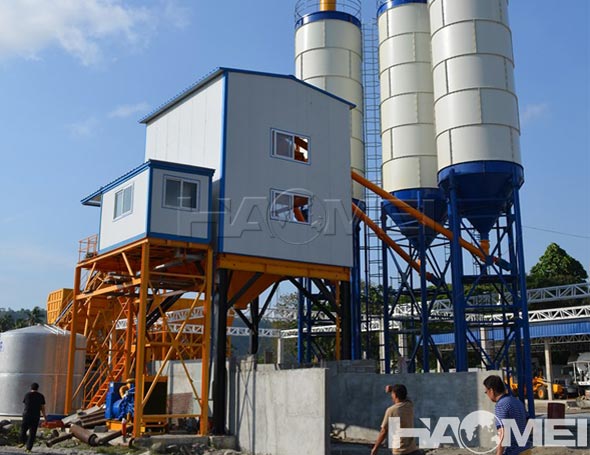
First, be wary of "hidden cost-cutting" in core components, which is the most common cost-cutting tactic used in cheap equipment. The mixing host, metering sensors, and main steel structure are the three core components of the entire concrete batching plant, directly determining the equipment's lifespan and production stability. Low-priced models often use non-standard thin steel plates instead of standard steel, compressing the thickness of the main steel structure from the standard 8-10mm to 5-6mm. While this may seem harmless in the short term, structural deformation and weld cracking will occur after 3-5 years of heavy-load operation, shortening the overall lifespan of the equipment by more than 40%. Regarding the mixing unit, some manufacturers use low-power motors to masquerade as standard equipment. For example, the HZS90 concrete batching plant should use dual 30kW units, but it actually uses dual 22kW motors, which are prone to burnout under long-term full-load operation. The metering sensors used are often off-brand products, with dynamic sampling errors exceeding ±4%, far exceeding the ±2% (aggregate) and ±1% (powder) requirements of the IEC 60335 industrial metrology standard. This directly leads to excessive dispersion in concrete strength and increases the defect rate by more than 30%. When purchasing, the brand, specifications, and materials of core components must be clearly specified, not just the model name.
Secondly, it is crucial to eliminate the "water" in capacity parameters and distinguish between theoretical capacity and actual continuous capacity. Cheap concrete batching plant equipment often only lists its theoretical peak capacity, avoiding mention of actual production rates. Equipment nominally rated at 90 m³/h may actually only achieve a continuous operating capacity of 60-70 m³/h due to mismatched efficiency in the batching and conveying processes, a production rate of less than 75%, far below the over 85% achieved by reputable manufacturers. For projects with tight schedules, insufficient capacity means extended construction periods, resulting in labor and downtime costs far exceeding the price difference saved during equipment purchase. Verification should not rely solely on manufacturer figures; it's crucial to clarify three core indicators: mixing cycle, parallel batching efficiency, and conveying capacity. For example, a standard HZS90 concrete batching plant must have a 60-second mixing cycle, simultaneous batching in four bins, and a belt conveyor efficiency of over 120 t/h. The absence of any one of these three is necessary to ensure that actual production capacity meets standards.
Thirdly, it's essential to calculate the total "hidden costs" to avoid saving small amounts upfront but incurring large expenses later. Many low-priced quotes only include the bare equipment, excluding installation guidance, spare parts, and after-sales support. For example, installing an HZS90 concrete batching plant without manufacturer technical guidance can extend the installation and commissioning cycle by 5-7 days, incurring thousands of dollars in additional labor costs. Spare parts are often not interchangeable, requiring subsequent procurement of liners and blades from the original manufacturer, which often costs over 40% more than the industry average, with delivery times exceeding one month. The losses due to downtime are incalculable. Reputable exporters like Haomei Machinery provide initial spare parts, multilingual installation guidance, and 24-hour remote technical support. While their quotes may seem slightly higher, they actually save customers significant hidden costs.
Finally, compliance and safety must not be compromised. Cheap concrete batching plant equipment often omits international certifications like CE, making it highly susceptible to customs seizure and even failing local safety inspections. Regarding safety features, some manufacturers omit standard features such as overload protection, emergency shutdown, and dust and noise reduction. While this reduces costs, it significantly increases construction safety risks and environmental compliance risks.
Ultimately, the core of low-price procurement is "controlling costs while maintaining a bottom line of quality," rather than blindly pursuing the lowest price. Choosing reputable manufacturers like Haomei allows for cost control through tiered configuration solutions, while also ensuring equipment performance, compliance, and after-sales support—this is the truly cost-effective option.