
Product Categories
News
Contact Us
Tel: +86-0371-65621392Fax: +86-0371-86616825
E-mail: info@haomei.biz
Address:No.14 Waihuan Road, New district, Zhengzhou, China
ZIP: 450046

What Is Mini Ready Mix Concrete Plant?
Writer:Admin Time:26/06/11In the field of concrete engineering, large commercial concrete batching plants are widely known, but mini ready mix concrete plants are the main equipment used in rural infrastructure, scattered construction sites and temporary projects. Many people have only a vague understanding of their positioning, specifications, and uses. Today, we'll explain this type of equipment in simple terms, combining industry standards and practical applications.
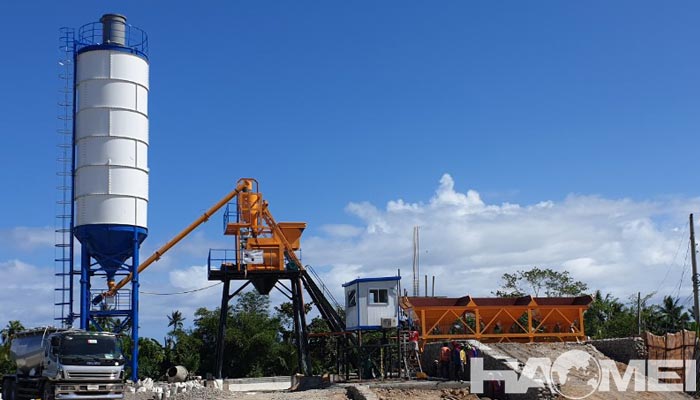
According to industry-standard classification, batching plants with a theoretical hourly output of 50 m³ or less are uniformly defined as mini ready mix concrete plants. The mainstream models on the market are HZS25, HZS35 and HZS50, which are also the most widely used categories in the global engineering market. The HZS25 can produce 25 cubic meters of concrete per hour, the HZS35 35 cubic meters per hour, and the HZS50 is capped at 50 cubic meters per hour. These production capacity parameters are the core basis for distinguishing between small and medium-to-large batching plants.
Mini ready mix concrete plants follow the working principle of standard commercial concrete plants, employing a modular assembly design. They are available in fixed and semi-mobile types, with fully mobile structures being rare. The complete set of equipment consists of a mixing host, aggregate batching machine, cement silo, metering system, electrical control system, and basic dust collection equipment, with only the component specifications simplified for compatibility. The mixing host is generally equipped with a twin-shaft forced mixer, whose mixing power and material uniformity fully meet engineering standards. The batching machine is mainly two- or three-compartment, capable of simultaneously batching sand, gravel, aggregates, and other raw materials. Only one or two cement silos are typically installed, with capacities mostly at 50 or 80 tons, and their compact size saves space. The control system is divided into simple electrical control and fully automatic batching systems. Basic models can be operated manually, while higher-end models can achieve automatic metering and data recording, making operation very easy.
Its small footprint is its most prominent feature, which is also the key to its suitability for niche applications. Once assembled, the HZS25 and HZS35 concrete batching plants occupy only 800-1200 square meters of floor space. Even the slightly larger HZS50 only requires 1200-1800 square meters, eliminating the need for large dedicated plant areas. They can be built on ordinary flat land or in corners of construction sites, minimizing initial investment.
In terms of application scenarios, mini ready mix concrete plants are designed for small-scale, short-radius, and temporary material needs. They don't undertake large-scale projects like large housing developments or main municipal roads. They primarily serve rural self-built houses, rural road hardening, small-scale farmland irrigation, town bridges, and minor urban repair projects. They also often serve as auxiliary concrete batching stations for large construction sites or as the main equipment for infrastructure projects in remote mountainous areas. Due to the initial setting characteristics of concrete, their material transportation radius is generally controlled within 5 kilometers to ensure output quality.
In terms of operation, mini ready mix concrete plant equipment offer significant advantages. The total equipment purchase and civil engineering investment is far lower than that of large commercial concrete mixing plants, making the investment threshold more accessible. Daily operation requires only 2-3 staff members to handle operation, inspection, and basic maintenance, resulting in low labor costs. Based on typical industry operating conditions (250 days a year, 8 hours a day), the annual production capacity of HZS25 is approximately 50,000 cubic meters, and the annual production capacity of HZS50 can reach 100,000 cubic meters, perfectly matching the material requirements of small-scale projects. Some semi-mobile models are easy to assemble and disassemble, and can be quickly moved and reused after temporary projects are completed, resulting in high utilization.
Mini ready mix concrete plants on the market are also divided into simplified, standard, and environmentally friendly upgraded versions. The simplified version simplifies the enclosure and dust removal facilities, suitable for remote areas with lax environmental regulations; the standard version is the mainstream in the market, with compliant configurations, suitable for most rural scenarios; the environmentally friendly version is equipped with an enclosed material shed and a water mist dust suppression device, allowing for compliant use around towns.
Many people mistakenly believe that mini ready mix concrete plants are " inferior equipment," but this is a misconception. It is a specialized piece of equipment tailored for a specific market segment, with performance perfectly adapted to corresponding working conditions. With the steady progress of urban and rural infrastructure construction, mini ready mix concrete plants, thanks to their flexibility, cost-effectiveness, and ease of operation and maintenance, consistently occupy an important position in the engineering equipment market and are an indispensable part of grassroots infrastructure construction.
- Previous:Overview of Ready Mix Concrete Batching Plants...
- Next:Ready Mix Concrete Plant Process Flow...