
Product Categories
News
Contact Us
Tel: +86-0371-65621392Fax: +86-0371-86616825
E-mail: info@haomei.biz
Address:No.14 Waihuan Road, New district, Zhengzhou, China
ZIP: 450046

Overview of Ready Mix Concrete Batching Plants
Writer:Admin Time:26/06/18Ready mix concrete manufacturing plants are core equipment for achieving industrialized and standardized concrete production. They centrally and precisely proportion and forcefully homogenize aggregates, cementitious materials, mixing water, and admixtures to produce finished ready mix concrete. They are a core facility in modern engineering construction, replacing on-site manual mixing and ensuring the stability of concrete performance.
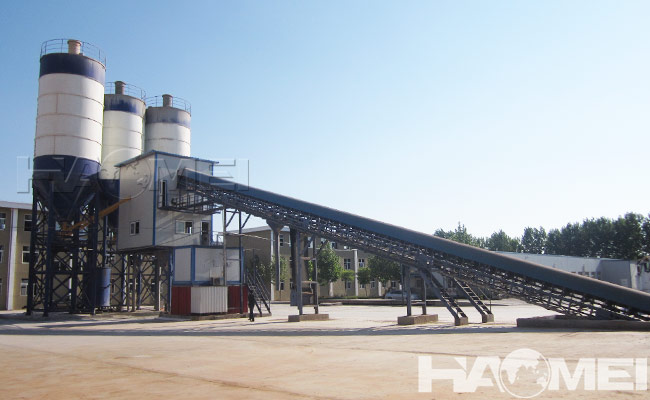
From a working principle perspective, the ready mix concrete manufacturing plant adopts a closed-loop production logic of "graded storage—precise metering—forced mixing—closed unloading." Raw materials are divided into four categories: coarse and fine aggregates, cementitious materials (cement, fly ash, mineral powder, etc.), mixing water, and functional admixtures. Each type of material is stored and metered independently to avoid cross-mixing. The equipment is equipped with an electronic weighing and metering system, with the metering error of coarse and fine aggregates controlled within ±2%, and the metering error of cementitious materials, water, and admixtures controlled within ±1%. This metering accuracy is far superior to manual on-site mixing. After weighing, the materials are fed into a twin-shaft forced mixer via a closed conveyor system. Through the shearing, tumbling, and pushing action of the bidirectional spiral blades, the solid and liquid materials are fully homogenized in a short time. The mixing time for a single batch of ordinary strength concrete is no less than 30 seconds, while the mixing time for high-strength, impermeable, and other special concretes is extended to 45-60 seconds. The final output is finished concrete with workability and strength indicators that meet design requirements.
Regarding model classification and capacity parameters, mainstream ready mix concrete manufacturing plants adopt the HZS series naming system. The suffix number indicates the theoretical hourly capacity of the concrete batching plant equipment (unit: m³). The industry typically categorizes equipment into four levels based on production capacity: small-scale ready mix concrete manufacturing plants with a theoretical hourly output of ≤60m³, represented by models HZS25, HZS35, and HZS50; medium-scale ready mix concrete manufacturing plants with a theoretical hourly output of 60-120m³, represented by models HZS90 and HZS120; large-scale ready mix concrete manufacturing plants with a theoretical hourly output of 120-240m³, with HZS180 currently serving as the mainstream benchmark in the commercial market; and extra-large ready mix concrete manufacturing plants with an output of 240m³ or more, primarily used in national-level mega-scale infrastructure projects. Due to actual operating conditions such as loading intervals and unloading wait times, the actual stable production capacity of the equipment is approximately 85%-90% of the theoretical value. Therefore, the selection of ready mix concrete manufacturing plant equipment for engineering projects should consider the total volume and schedule requirements, allowing for a reasonable margin.
The core technological features of ready mix concrete manufacturing plants are reflected in four aspects:
First, a high degree of automation in production; the entire process can be centrally controlled through a central control system, requiring only 2-3 people per shift for on-duty and inspection.
Second, controllable and traceable quality; production data is automatically retained, and the mix proportions, mixing time, and raw material information for each batch of concrete are traceable, meeting engineering quality acceptance standards.
Third, flexible deployment options; both fixed permanent sites suitable for long-term operation and modular semi-mobile sites can be quickly disassembled and relocated according to project cycles.
Fourth, continuously upgraded green production attributes; mainstream sites are equipped with enclosed silos, pulse dust collectors, and spray dust suppression systems, effectively controlling dust and noise pollution and complying with current environmental protection standards.
In terms of application scenarios, small-scale ready mix concrete manufacturing plants are suitable for scattered projects such as rural infrastructure, small-scale water conservancy, and minor municipal repairs, offering advantages such as small footprint and low investment threshold. Medium-sized ready mix concrete manufacturing plants are mostly used for commercial concrete supply in county-level areas and medium-sized real estate and municipal projects. Large-scale ready mix concrete manufacturing plants primarily serve the core commercial concrete market in cities, as well as large-scale linear projects such as high-speed railways and highways. Mobile ready mix concrete manufacturing plants are specifically used in special scenarios such as remote mountainous areas and emergency repairs where transportation is restricted and construction schedules are tight.
Overall, ready mix concrete manufacturing plants achieve stable and controllable concrete performance through industrialized production models, making them an indispensable core piece of equipment in the modern industrialized construction engineering system.
- Previous:Core Parts of Concrete Batching Plants...
- Next:What Is Mini Ready Mix Concrete Plant?...