
Product Categories
News
Contact Us
Tel: +86-0371-65621392Fax: +86-0371-86616825
E-mail: info@haomei.biz
Address:No.14 Waihuan Road, New district, Zhengzhou, China
ZIP: 450046

Concrete Batching Plant Breakdown And Solutions
Writer:Admin Time:26/07/16Concrete batching plant breakdowns are complex, but the vast majority are concentrated in four main modules: the mixing host, metering system, conveying system, pneumatic and electrical control systems. Non-professionals often fall into the trap of "trial and error" by replacing parts, which not only delays production but may also mask underlying problems. Truly efficient fault handling should follow the logic of "system-based troubleshooting, tracing the root cause from the symptoms, and investigating from the surface to the core." First, determine the module to which the fault belongs, then narrow down the scope layer by layer, and finally solve the problem at its root. The following outlines the professional troubleshooting approach and solutions for high-frequency faults by system.
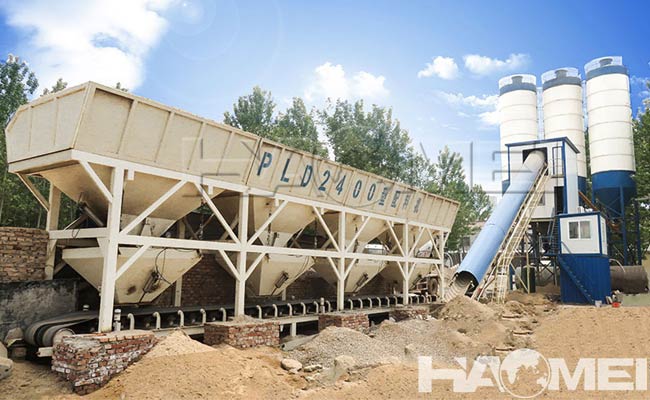
The mixing host system has the highest failure rate, with shaft end leakage being the most typical common problem. Many people directly replace the seals when encountering leakage, ignoring the true cause of the seal failure. Professional troubleshooting should proceed in three steps: First, check if the automatic lubrication system is supplying oil normally—approximately 60% of slurry leaks originate from blocked lubrication lines or malfunctioning grease pumps causing dry friction on the sealing surfaces. Second, check if the coaxiality of the mixing shaft exceeds the standard, as shaft misalignment will accelerate one-sided wear of the seals. Finally, consider whether the seals themselves have reached the end of their service life. Another common fault is an abnormally high mixing current accompanied by unusual noises. First, check for large-diameter aggregates or metal foreign objects stuck in the blade gaps, then check if the liner blades are loose or detached. After ruling out mechanical factors, consider faults in the motor and reducer themselves.
Metering system malfunctions directly affect concrete quality and are often difficult to detect and easily misdiagnosed. The most common issue is continuous deviation in powder weighing. If the deviation is stable and unidirectional, it is often due to sensor zero-point drift or parameter setting problems, which can be resolved by recalibrating the scale; if the deviation fluctuates randomly, check for mechanical jamming on the scale—for example, clumping of flexible connections or dust accumulation at the screw conveyor outlet against the weighing hopper, all of which can exert additional force and interfere with weighing. Inaccurate metering of water and additives requires careful investigation, focusing on whether solenoid valves are not closing tightly and whether there are air leaks in the pipelines causing air blockages. These issues are particularly noticeable in low-ratio formulations.
Conveying system malfunctions are most commonly seen in screw conveyor blockages and belt misalignment. For screw conveyor blockages, simply clearing the material and restarting is insufficient; the cause of the blockage must be identified: is it due to excessive moisture content at the inlet causing powder bridging, incomplete opening of the outlet gate, or insufficient output torque from the motor and reducer? Stations experiencing recurring blockages often have undersized conveyor capacity or poor powder flowability, requiring optimization at the source. Belt misalignment follows the principle of "running tight, not loose; running high, not low": unloaded misalignment is often due to roller parallelism issues, while heavy-load misalignment requires checking the alignment of the idler roller brackets with the material drop point; passively adjusting the idler rollers alone is insufficient.
Pneumatic and electrical control system malfunctions often manifest as actuator failures. When air pressure is insufficient, first check the air compressor itself, then check for leaks in the pipeline and blockages or water accumulation in the oil-water separator. Many recurring instances of sluggish pneumatic valve operation are actually caused by inadequate air supply processing leading to premature wear of the cylinder seals. For intermittent electrical control faults, focus on checking grounding and shielding. Mixed wiring of sensor signal lines and power lines, and loose grounding connections can all cause irregular signal fluctuations and false alarms.
Ultimately, advanced breakdown handling ability lies in prediction rather than emergency repair. Establishing a fault log categorized by system, recording the phenomenon, cause, and handling method of each fault, allows you to gradually understand the wear patterns of equipment, transforming reactive repair into proactive preventative maintenance, and minimizing the risk of production interruptions.
- Previous:[Haomei News]...
- Next:Four Things To Note When Buying Cheap Concrete Batching Plant...