
Product Categories
News
Contact Us
Tel: +86-0371-65621392Fax: +86-0371-86616825
E-mail: info@haomei.biz
Address:No.14 Waihuan Road, New district, Zhengzhou, China
ZIP: 450046

Trailer Mobile Concrete Batching Plants
Writer:Admin Time:26/10/15Projects such as highway maintenance, rural road upgrades, bridge component prefabrication, water channel construction, and emergency urban repairs share common challenges: geographically dispersed work sites, limited concrete volume requirements per segment, and tight project schedules. Setting up a stationary concrete batching plant—from pouring foundations to erecting silos and completing electrical connections—can easily take a month or more, making it economically unfeasible for short-term projects. Alternatively, transporting concrete from a distant stationary concrete batching plant often leads to a loss of slump, a problem that becomes even more pronounced during winter or in high-temperature seasons. Trailer mobile concrete batching plants are specifically engineered for these types of scenarios.
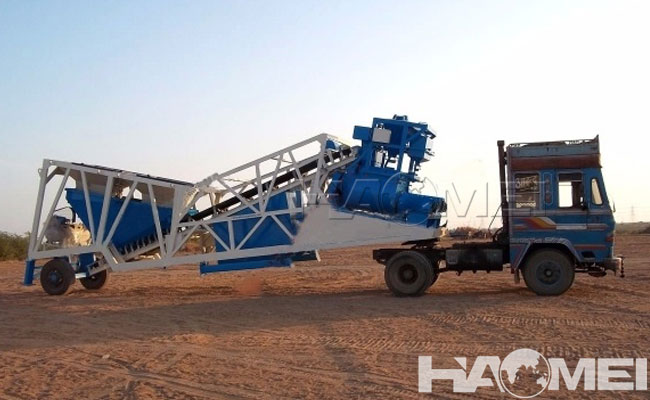
The Trailer Chassis: The Key to Easy Relocation
Mobile concrete batching plants generally fall into two structural categories. The first is the "towed" (full-trailer) type, which features both front and rear axles and the necessary running gear. The second is the "towable" (semi-trailer) type; this design utilizes only a rear axle, with the front end resting on the fifth-wheel coupling of a tractor unit. This configuration results in a more compact overall length, a smaller turning radius, and better compliance with highway transport regulations. Haomei YHZS series mobile concrete batching plant follows the latter approach, integrating material storage, weighing, conveying, mixing, discharging, and a fully automatic control system into a single semi-trailer unit.
The level of integration determines the speed of relocation. During operation, the trailer mobile concrete batching plant is supported by hydraulic outriggers. The control room is housed within the chassis of the main unit; it serves as a front support point during operation and can be folded upward into the frame for transport. Walkways, railings, and extension panels are connected via pins, allowing them to be folded down and transported along with the plant. All control cables utilize quick-connect plugs, eliminating the need for disassembly during relocation. With the exception of the cement silo and screw conveyor—which are external, modular components—the main plant can be prepared for transport by retracting the outriggers and attaching it to a towing vehicle, enabling it to be moved between job sites at speeds of up to 15 km/h. On a level, solid site, no concrete foundation is required; once the outriggers are leveled and power and water connections are established, the mobile concrete batching plant can be operational within 2 to 3 days. Depending on transport requirements, the cement silo can be configured as either a horizontal unit or a modular vertical unit.
Haomei YHZS Series: Models and Specifications
Haomei offers six configurations—YHZS25, YHZS35, YHZS50, YHZS60, YHZS75, and YHZS100—with the following key specifications:
|
Model |
Theoretical Capacity |
Mixing Unit |
Discharge Capacity |
Total Installed Power |
Discharge Height |
Max. Aggregate Size
|
|
YHZS25 |
25 m³/h |
JS500 |
500 L |
≈60 kW |
3.8 m |
60/80 mm |
|
YHZS35 |
35 m³/h |
JS750 |
750 L |
≈65 kW |
3.8 m |
60/80 mm |
|
YHZS50 |
50 m³/h |
JS1000 |
1000 L |
≈85 kW |
3.8 m |
60/80 mm |
|
YHZS60 |
60 m³/h |
JS1000 |
1000 L |
≈90 kW |
3.8 m |
60/80 mm |
|
YHZS75 |
75 m³/h |
JS1500 |
1500 L |
≈105 kW |
3.8 m |
60/80 mm |
|
YHZS100 |
100 m³/h |
JS2000 |
2000 L |
≈145 kW |
4.0 m |
60/80 mm |
Each unit features a JS-series twin-shaft forced mixer, capable of processing dry-hard, plastic, and flowable concrete, as well as mortar. The weighing system utilizes electronic scales and sensors, achieving an accuracy of ±2% for aggregates and ±1% for cement, water, and admixtures—matching the standards of stationary concrete batching plants of the same capacity. The system is fully automated via PLC, with support for manual/automatic switching, and allows for the storage and printing of production reports. Aggregates are fed via a chevron-pattern (V-shaped) conveyor belt set at an incline of approximately 20°, which minimizes material spillage. The entire plant is designed for containerized transport; for export orders, motors can be configured to match local voltage and frequency (50/60 Hz) requirements.
Applicable Scenarios
A trailer-mounted mobile concrete batching plant is not a "universal solution," but it offers the best cost-performance ratio for three specific types of projects:
First, infrastructure projects—such as highways, railways, or irrigation canals—that span long distances with scattered work sites; the plant can be towed from one location to the next, eliminating the need for repeated dismantling and reassembly.
Second, small-to-medium-scale projects with durations ranging from a few months to a year and total volumes between several thousand and tens of thousands of cubic meters; for these, the high costs of constructing foundations for a stationary plant and subsequent site clearance are not economically justified.
Third, projects with space constraints, such as municipal emergency repairs or expansions at airports and ports; these mobile units occupy only about half the footprint of a stationary plant with equivalent capacity.
Selection Guidelines
When selecting a model, verify three key conditions:
First, ensure that the roads between work sites can accommodate a semi-trailer, and confirm the availability of a towing vehicle and necessary transport permits.
Second, check the power supply; most YHZS-series models require a stable 380V industrial power source—if grid power is unavailable, a diesel generator set will be needed.
Third, ensure the number and capacity of the aggregate bins align with your mix design; for standard operations using two to four types of aggregates, choose a 2-bin or 4-bin configuration, with the option to increase capacity using bin-extension plates.
Regarding wear parts—such as shaft-end seals, conveyor idlers, and mixer blades/liners—it is advisable to include a full set of spares with the initial shipment. For overseas projects, where lead times for spare parts can be long, ordering everything at once is more cost-effective than arranging multiple air-freight shipments.
- Previous:[Haomei News]...
- Next:How Does A Mobile Concrete Plant Work?...