
Product Categories
News
Contact Us
Tel: +86-0371-65621392Fax: +86-0371-86616825
E-mail: info@haomei.biz
Address:No.14 Waihuan Road, New district, Zhengzhou, China
ZIP: 450046

Mobile Batching Plant Prices
Writer:Admin Time:26/10/21With over a decade of experience in exporting concrete equipment, we know that price is consistently the primary concern for our overseas clients. The mobile batching plant price varies significantly based on production capacity, configuration, customization requirements, and delivery terms; therefore, a "low price" quoted without specifying the configuration holds little practical value. Based on Haomei Machinery’s 2026 standard FOB (China port) pricing, our YHZS series offers a clear price structure, designed to align with the budgets of various international infrastructure projects.
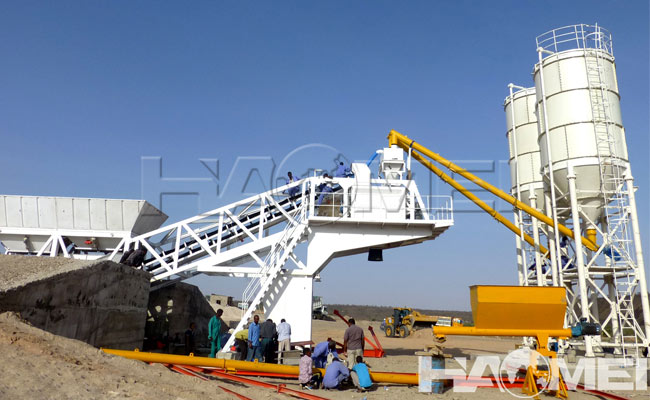
The standard-configuration models in YHZS series mobile batching plants range from $38,000 to $135,000 USD. This standard setup includes a twin-shaft forced mixer, a multi-compartment aggregate batching system, independent weighing units for various materials, a basic PLC control system, and a pulse-jet dust collection system. All units undergo comprehensive integrated testing before leaving the factory. Please note that this pricing excludes cement silos, additional conveying equipment, or custom modifications. The entry-level YHZS25 model, with a theoretical capacity of 25 m³/h, is designed for small-scale, scattered repair projects and is priced at $38,000–$45,000 (FOB). The flagship YHZS35 model, featuring a theoretical capacity of 35 m³/h, is the most widely purchased unit globally for small-to-medium infrastructure projects, with an FOB price of $46,000–$53,000. The mid-range YHZS50 and YHZS60 models offer theoretical capacities of 50–60 m³/h and are suited for small-to-medium municipal and industrial facility construction, priced at $58,000–$88,000 (FOB). The high-capacity YHZS90 model, with a theoretical capacity of 90 m³/h, is intended for medium-to-large-scale construction projects and is priced at $98,000–$135,000 (FOB).
Taking the YHZS35 mobile batching plant—the best-selling standard model globally—as an example, its cost structure can be broken down into four core modules.
The first is the mixing unit and power system, which accounts for approximately 40% of the total cost. At its heart is the JS750 twin-shaft forced mixer, equipped with wear-resistant high-manganese steel liners and mixing blades, specialized gear motors, and a pneumatic discharge system; this module is the primary determinant of mixing efficiency, concrete quality, and equipment service life.
The second module, comprising about 25% of the cost, consists of the mobile chassis and structural components—including the towable chassis, four hydraulic support legs, a three-compartment aggregate batching bin, and the belt conveyor frame—which facilitate site relocation and rapid, foundation-free installation.
The third module, accounting for roughly 20% of the cost, covers the weighing and electrical control systems. This includes weighing hoppers for aggregates and cement, independent weighing units for water and admixtures, a PLC control cabinet, and high-precision sensors, all of which directly dictate the accuracy of concrete mix proportions and the level of production automation.
The fourth category consists of environmental protection equipment and auxiliary components, accounting for approximately 15% of the total. This includes pulse-jet dust collectors, centralized lubrication systems, pneumatic components, and safety guards, all of which ensure the equipment meets environmental standards and operates reliably over the long term.
Optional features tailored to specific operating conditions come with clearly defined price adjustments. For a standard 50-ton modular cement silo, the addition of a screw conveyor and a roof-mounted dust collector increases the price by $8,500–$12,500 per unit. Upgrading to a fully automated intelligent control system—featuring touchscreen operation, production data logging, and self-diagnostic functions—adds $6,000–$9,000. For specialized operating environments, modifications such as oil-line heating and silo insulation for extremely cold regions add $4,000–$6,000, while full dust-sealing and forced-cooling upgrades for high-temperature, sandy environments add $3,000–$5,000.
Drawing on over a decade of export experience, we have observed that price differences of 15% or more between identical equipment models are often the result of "hidden" reductions in specifications. Some manufacturers use a low "base unit" price to attract customers—omitting essential components like dust collection systems or complete weighing mechanisms—only for the customer to end up paying more than 10% above the original budget once these necessary parts are purchased later. When purchase mobile batching plant equipment, it is crucial to clarify the full list of specifications and the scope of services provided. Aligning the equipment configuration with the specific requirements of your project is the only way to effectively manage total lifecycle costs. At Haomei Machinery, every quote is accompanied by a detailed specification list with no hidden charges; furthermore, our global service network ensures comprehensive, end-to-end support for our customers.
- Previous:[Haomei News]...
- Next:Trailer Mobile Concrete Batching Plants...